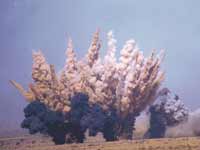
Indian Scientist Claims Pokhran Nuclear Tests Were Unsuccessful

Pokhran IIA senior scientist and DRDO representative at Pokhran II has admitted for the first time that the May 1998 nuclear tests may not have been as successful as has been projected and also emphasized the need for India to conduct more tests to improve its nuclear weapon programme. The Indian security establishment on Thursday reacted with dismay to suggestions by top nuclear scientist K Santhanam.

India conducted five nuclear tests at the Pokhran test range. Three of them were conducted on May 11 and two on May 13, 1998. The team which conducted tests was headed by Rajagopala Chidambaram and the Device was developed at the Defence Research and Development Organization or DRDO’s Terminal Ballistics Research Laboratory.

Santhanam has disclosed that the thermonuclear explosions conducted at that time were ‘actually of much below expectations and the tests were perhaps more a fizzle rather than a big bang.’

In nuclear parlance, a test is described fizzle when it fails to meet the desired yield. India had claimed at time that test yielded 45 kilotons (KT) but this claim was challenged by western experts who said it was not more than 20 KT. In fact, some scientists, notably top nuclear seismology expert Terry Wallace, then with the University of Arizona and now attached to the Los Alamos National Laboratory, put the combined yield of the three May 11 tests at as low as 10 to 15 kilotons. Two other tests on May 13 involved sub-kiloton devices for tactical weapons, which US scientists doubted even took place.

Santhanam’s view was shared by nuclear scientist Subramaniam who said “there was something wrong with the seismic signals which seemed pretty weak to me then. So I would tend to agree with Santhanam”.

The security expert Bharat Karnad said Santhanam’s admission is remarkable because this is the first time a nuclear scientist and one closely associated with the 1998 tests has disavowed the government line. “This means the government has to do something. Either you don’t have a thermonuclear deterrent or prove that you have it, if you claim to have it,” said Karnad.

The exact yield of the thermonuclear explosion is important as during the heated debate on the India-US nuclear deal Indian government is under pressure from the international non proliferation lobby, to sign the Comprehensive Test Ban Treaty (CTBT). It was said the disincentive the nuclear deal imposed on testing would not really matter as further tests were not required.

Brajesh Mishra, the Former National Security Advisor in the NDA regime under Atal Behari Vajpayee rejected top nuclear scientist K Santhanam’s charges.

He said, “Dr APJ Abdul Kalam who was scientific advisor to the Defence Minister in 1998 had openly said that the nuclear test in Pokharan in 1998 was enough and we could sign the Indo-US Nuclear deal. Dr Santhanam was working directly under Dr Kalam and both were present when Pokharan took place. That should answer any questions about the test.”


Posted

in

,

by

Tags:

Comments

55 responses to “Indian Scientist Claims Pokhran Nuclear Tests Were Unsuccessful”

  1. confused indian Avatar
    confused indian

    @hamin, your comments remind me of film ‘shool’, made by prakash jha. in this film villain, a legislator, vehemently protest a dam by saying that they don’t need water of which electricity have been taken out. (hame bijle nikli hui pani nahi chahiye!)

    thanks for today’s laughing dose.

  2. Hend Avatar
    Hend

    Abbasi
    As expected you have resorted to evasive replies. I quoted the report given by World Bank which was called by Pakistan to resolve the dispute and you have quoted some non-descript and inflamatory article which peddles nothing but illegal objections.

    The last part of that article is pure nonsense and proved by the World Bank report. Read.

    “The Indus Waters Treaty of 1960 divided the Indus river — into which the Chenab flows — between the two countries and bars India from interfering with the flow into Pakistan while allowing it to generate electricity. However the key issue that any dam constructed by India should be strictly run of the mill was rejected”.

    It is clear you have no valid argument. Quoting cry baby articles written in Jung and Dawne is not research. There is a treaty and the text of the treaty is available on the internet. Please read it.

  3. Hamid Majid Abbasi Avatar

    @hend
    may be this will open the closed liberal eyes of urs…………although i dnt claim it needed a research………its available online…………

    “”Quite close to Pakistan-India border, on the river Chenab, Pakistan has three large headworks of Marala, Khanki and Quadirabad, feeding large tracts of agricultural fields in Neeli Bar, Ganji Bar and Sandal Bar areas. The Baghliar Dam would, thus, provide New Delhi leverage to stop the flow of the river Chenab at will and strangulate Pakistan’s agriculture.

    Pakistan has serious technical objections to Baghliar Dam’s design because the project is not restricted to power generation but also enables India to divert over 7,000 cusecs of Chenab water per day for irrigation purposes in violation of 1960 Indus Basin Treaty. Under the Treaty, India is permitted to generate electricity but it cannot divert the flow of river water. The average annual flow in river Chenab is 25.9 MAF (Million Acre Feet), which is approximately 1.6 times that of the flow of river Sutlej.

    The 1960 Indus Water Treaty was negotiated following the rising tensions between India and Pakistan after New Delhi stemmed the flow of Indus tributaries to Pakistan on April 1, 1948. Under the Indus Water Treaty, India has rights to waters of rivers Sutlej, Ravi and Beas while Pakistan to the waters of the rivers Indus, Chenab and Jhelum as a lower riparian.

    India and Pakistan have held many rounds of technical experts’ meetings and official level talks to sort out their differences on the Baghliar Dam Project, but these talks have failed to produce any results so far.

    Pakistan objects to Baghliar Dam’s construction because it cannot be used to store Chenab’s waters. The project provides for submerged gate spillways, allowing India to increase the dam’s storage capacity to 164,000 acres feet and capability to stop water for about 26 days during December, January and February.

    The Baghliar Dam project is a violation of the Indus Basin Water Treaty because under its terms, India cannot construct any project on the river Chenab without Pakistan’s prior approval.””

    i hear a chicken crying justice!!!!!!!!!!!!!!!!

  4. Hamid Majid Abbasi Avatar

    @hend
    as if you have found the lost castle of solomon…………it makes the same meaning as the discussion did…………may b some people like to bite dust from every where just to grab a simple common sense…………..which is that your original design was objected…………so iz it difficult for you to understand………..
    and mud………..may be i waz removing dirt from a greasy mind rather than sticking mud

  5. Hend Avatar
    Hend

    From this report it looks like Pakistan did not accept the same adjustments which were already offered by India and tried to grab more than its share of the pie.

    Just clarifying this because many uninformed people are repeating the same accusations instead of knowing the facts or possibly inspite of knowing the facts 🙂

  6. Hend Avatar
    Hend

    Abbasi

    Read below and then form your opinion about water dispute. Stop throwing mud around hoping something will stick. there is no substitute to the hard work of doing research and finding the truth.

    The World Bank in May 2005 appointed Professor Raymond Lafitte, a Swiss civil engineer, to adjudicate the difference.

    Lafitte declared his final verdict on February 12, 2007, in which he upheld some minor objections of Pakistan declaring that pondage capacity be reduced by 13.5%, height of dam structure be reduced by 1.5 meter and power intake tunnels be raised by 3 meters, thereby limiting some flow control capabilities of earlier design.

    However he rejected Pakistani objections on height and gated control of spillway declaring these were conforming to engineering norms of the day.

    India had already offered Pakistan similar minor adjustments for it to drop its objection.

    The Indus Waters Treaty of 1960 divided the Indus river — into which the Chenab flows — between the two countries and bars India from interfering with the flow into Pakistan while allowing it to generate electricity. However the key issue that any dam constructed by India should be strictly run of the mill was rejected. Pakistan government expressed its disappointment at the final outcome.

    Both parties (India and Pakistan) have already agreed that they will abide by the final verdict.

    I am sure even after reading this you will have some doubts or disbelief but I cannot help your plight.

  7. Hamid Majid Abbasi Avatar

    @hend
    well well well………..its seems that fantasy has been renamed in ur town as misperception…………
    nyhow leave my research aside………..Pakistan wanted to object the design and that it achieved,,,,,,,,,,,,rest our aspiration you can dig with pleasure

  8. Hend Avatar
    Hend

    Abbasi
    I have stated the fact about Kashmir and you have chosen to state your fantacy. If you choose to pour your billions in trying to attack India, that is fine, I have no complaint. It is also fact which India has to deal with, no issues.

    Water dispute: Pakistan objected to the dam itself, not to some minor parameters. You need to reasearch in more depth.

  9. Hamid Majid Abbasi Avatar

    @hend
    amendment for your geography books………kashmir is not India nor it will be……..our billions went for a legitimate freedom struggle and your billions went to supoprt an illegitimate regime whether sheix abdullah or his son………
    and if u c i also said that the design was amended and this was the thing Pakistan stressed the most

  10. Hend Avatar
    Hend

    Abbasi
    you seem confused about the Kashmir issue. Kashmir is in India and the influx of billions in money, arms and insurgents over many years has come from Pakistan if I am not mistaken. All the crying currently seems to be from Pakistan about India doing something similar in Balochistan, Sindh and Afghanistan. This is in line with what I mentioned earlier that both sides are doing their bit to destabilize each other. It not in the hands of common people like you and me to stop it overnight. We just have to accept it for a fact and hope that some day things might improve but for that the mindsets on both sides have to change. In my opinion this kind of change can take a couple of more generations.

    For the water dispute on Baghlihar I think the world bank consultant suggested only minor adjustments to the Indian design but essentially rejected the Pakistani appeal. Essentially we have to respect the mechanism of the treaty and arbitration for the disputes. But my objection is to the use of word ‘block’ as used by Lakhani saab as if to imply that the water was stopped. The word was used in the media to imply that there was some reduction in the flow of the water. We have to use our common sense here and understand that India cannot stop water not only because of the treaty but also its not possible practically without flooding the Indian side and moreover if India were to do that really! then Pakistan would be dry like sand within days. Such disputes over flow of water or gas or oil etc are common everywhere in the world, just recenty take Russia and Ukraine for example. To suggest that one India is out to destroy Pakistan by stopping water is rubbish.

Leave a Reply to James Killian Spratt Cancel reply

Your email address will not be published. Required fields are marked *